Looking for implementation? See our voice AI development services for UK businesses.
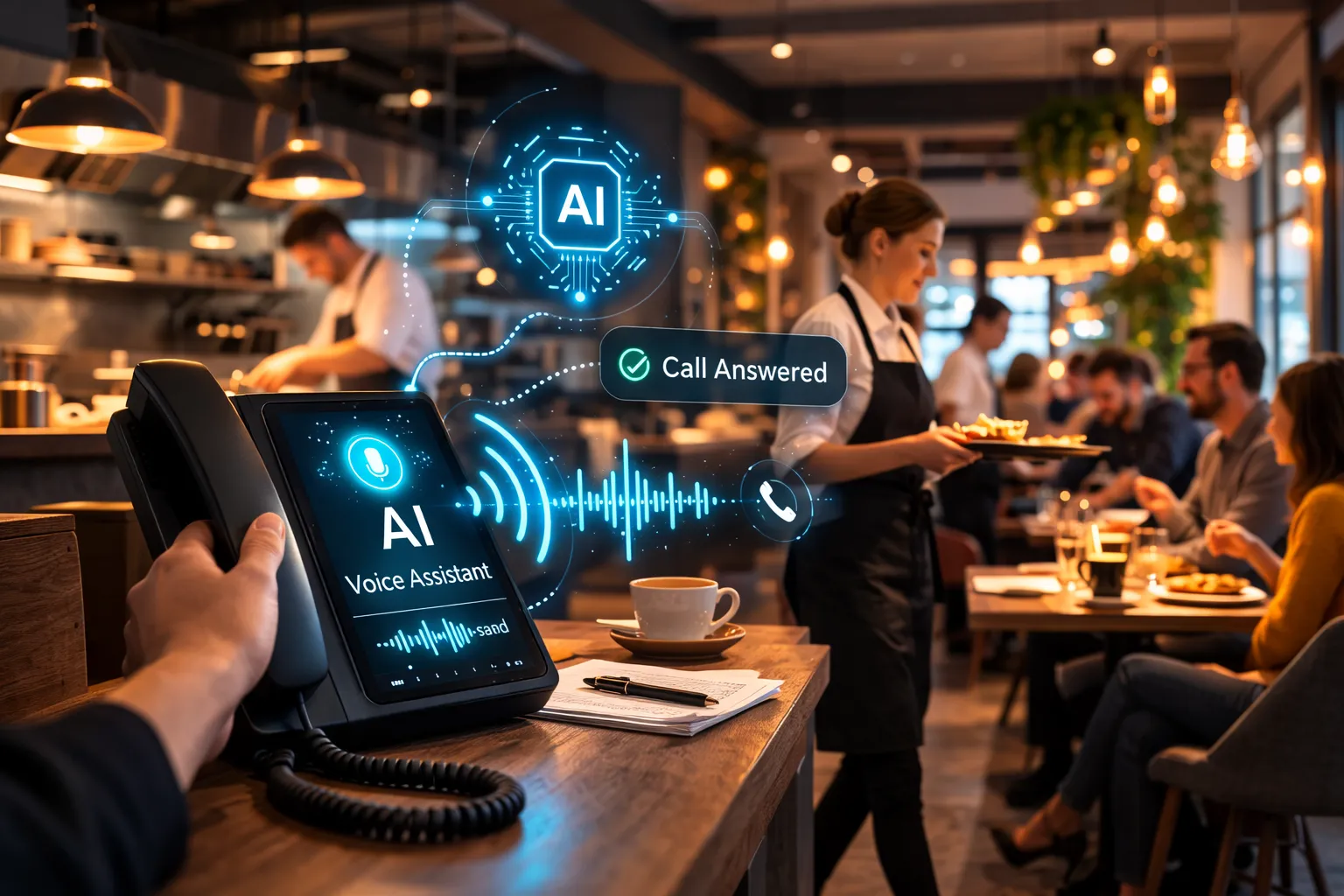
Voice AI for restaurants is an automated phone-answering system that uses natural language processing to handle bookings, enquiries, and order taking without human intervention. Unlike traditional IVR systems, modern voice AI enables natural conversations and integrates directly with restaurant management platforms.
The short version: Voice AI answers routine restaurant calls so your team can focus on guests. It handles reservations, opening hours, and menu questions—but knows when to hand off complaints and complex requests to humans. Works alongside your staff, not instead of them.
Your restaurant is fully booked on a Saturday night. The phone rings during service. It rings again. And again.
By the time someone manages to answer, the caller has already hung up — and likely booked somewhere else.
This is not a technology problem. It is an operational reality in modern restaurants.
Voice AI for restaurants is a conversational phone system that answers calls automatically and speaks naturally with customers. Instead of voicemail or button-based phone menus, callers simply explain what they need — and receive an immediate, accurate response.
The system works alongside your team, not instead of them.
Understanding what voice AI should handle — and what it should not — is what determines whether it improves restaurant operations.
What Voice AI Is
Voice AI is designed to handle the calls that interrupt service but do not require human judgement.
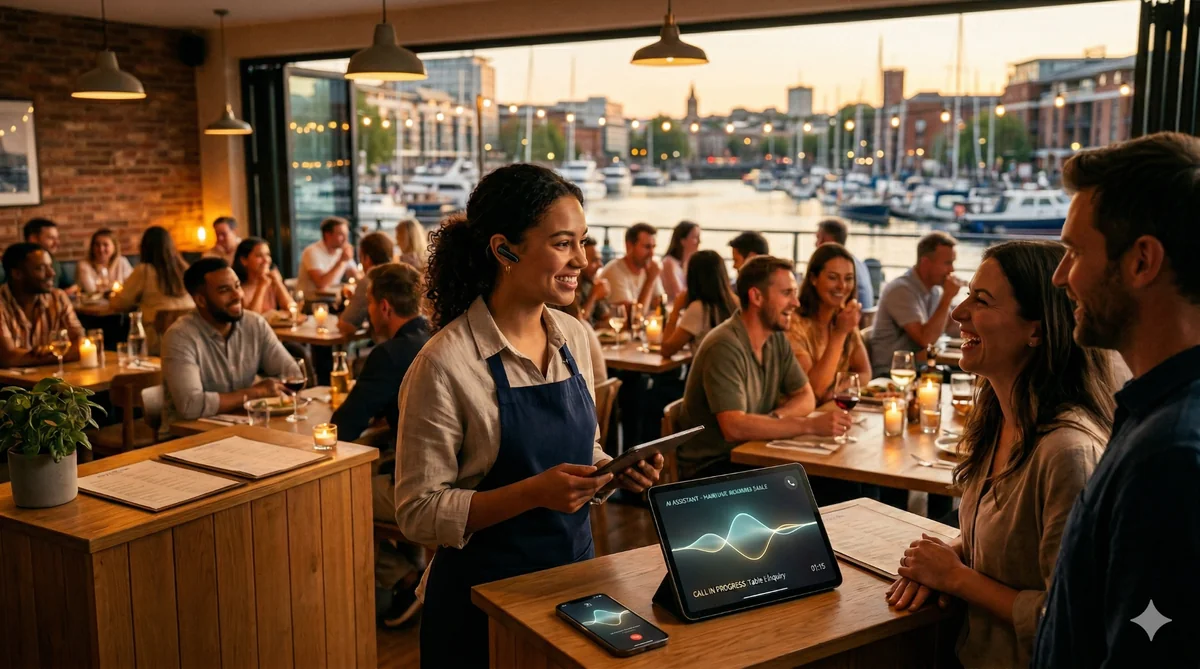
When a customer calls your restaurant, the system answers immediately, listens to the caller's request, and responds naturally — without scripted menus or button prompts.
Instead of hearing:
"Press 1 for reservations. Press 2 for opening hours."
A caller might simply say:
"Hi, do you have a table for four tonight?"
The system understands the request and responds appropriately.
Simple requests are handled automatically. More complex situations are transferred to restaurant staff.
The experience is designed to feel like speaking with a staff member who answers the phone quickly and efficiently.
What Voice AI Can Handle
Voice AI performs best when conversations follow predictable patterns. These represent the highest-volume calls most UK restaurants receive.
Reservations
Voice AI can:
- Check table availability
- Confirm booking details
- Handle simple reservation changes
- Record customer contact information
Customers receive instant confirmation without waiting for a staff member.
Opening Hours and Location
Restaurants regularly receive calls asking:
- What time do you open?
- Are you open today?
- Where are you located?
Voice AI provides consistent, accurate answers instantly.
Menu and Dietary Questions
Customers frequently ask about:
- Vegetarian or vegan options
- Allergen information
- Specific menu items
- Price ranges
Voice AI provides clear answers based on your current menu data.
Busy Service Calls
During peak hours restaurants may receive dozens of calls simultaneously. Voice AI answers multiple calls at once without pulling staff away from the floor.
After-Hours Enquiries
Customers often search for restaurants late in the evening. Voice AI allows restaurants to capture reservations even when the restaurant is closed.
Operational insight: In our UK restaurant deployments, we observed that restaurants miss approximately 20–40% of incoming calls during busy service periods. Voice AI ensures every caller receives an immediate response regardless of how full the floor is.
What Voice AI Is Not
Voice AI is not a replacement for hospitality.
Human judgement, empathy, and flexibility remain essential in many situations. A well-designed system recognises these scenarios and transfers calls to staff immediately.
Calls That Require a Real Person
Customer complaints
A dissatisfied guest needs to speak with someone who can listen, respond with empathy, and resolve the issue in real time.
Angry or distressed callers
Emotional situations require a human response.
Complex requests
Accessibility requirements, unusual seating arrangements, or multi-part booking changes require flexibility.
Private events and large group bookings
Weddings, corporate dinners, and large reservations require negotiation and direct human involvement.
Returning guests with special preferences
Regular customers often appreciate personal service.
The system's value depends on how clearly these boundaries are defined during setup.
Why UK Restaurants Are Adopting Voice AI
Restaurants are adopting voice AI because the operational gap between call volume and staff availability has become unsustainable.
Rising Labour Costs
Front-of-house staffing costs continue to increase across the UK hospitality sector.
Dedicating a staff member specifically to answering phones rarely makes economic sense — but missed calls directly impact bookings.
Voice AI resolves this trade-off.
Customer Expectations Have Shifted
Customers expect immediate responses. If a call rings out, many diners simply contact another restaurant.
This is especially true for:
- Same-day bookings
- Weekend reservations
- Group enquiries
The restaurant that answers first frequently secures the booking.
Phone Calls Still Matter
Despite online booking platforms, many customers still prefer to call — particularly when they have a specific question.
Common examples include:
- "Are you open today?"
- "Do you have availability tonight?"
- "Is your menu suitable for vegetarians?"
- "Where are you located?"
Voice AI answers these questions instantly.
Consistency Across Locations
Restaurant groups often face inconsistencies between locations.
Voice AI provides a single centralised source of information so every caller receives the same accurate response.
Protecting Hospitality
Restaurants adopting voice AI are not trying to automate hospitality.
They are trying to protect it.
By removing repetitive phone-handling from front-of-house responsibilities, staff can focus on:
- Service quality
- Guest experience
- Problem solving
- Atmosphere management
Technology handles operations. People handle hospitality.
Case Study: A 4-Location Restaurant Group
A UK restaurant group operating four locations experienced heavy call volumes during peak service hours.
Managers frequently had to step away from the floor to answer calls, while many customer enquiries went unanswered.
Situation Before Implementation
- High inbound call volume during evening service
- Missed reservation enquiries during peak periods
- Managers pulled away from guests
- Inconsistent information across locations
Implementation
Voice AI became the first point of contact for incoming calls and was configured to handle:
- Reservation enquiries and availability checks
- Menu and dietary questions
- Opening hours
- Location-specific information
Calls involving complaints or complex requests were transferred to staff.
Results
Within the first few weeks:
- In our UK restaurant deployments, we observed up to a 60% reduction in missed calls
- In our UK restaurant deployments, we observed a 35% increase in same-day bookings
- Reduced staff interruptions
- More consistent customer information across locations
Most callers simply experienced a quick, helpful conversation.
Many did not realise the system was automated.
How Voice AI Is Built for Restaurants
Effective voice AI reflects real restaurant operations rather than a generic template.
Implementation typically follows five stages.
Step 1 — Call Pattern Analysis
The process begins by analysing actual call behaviour including common questions, peak call periods, booking workflows, and scenarios requiring staff transfer.
Step 2 — Defining System Boundaries
Clear rules determine which conversations the system handles automatically and when calls should transfer to staff.
Step 3 — Configuring Restaurant Information
The system is loaded with accurate operational data including:
- Opening hours and seasonal variations
- Menus and allergen information
- Reservation policies
- Location-specific information
Step 4 — Real-World Testing
Before launch the system is tested under realistic service conditions including last-minute booking requests and edge-case customer questions.
Step 5 — Ongoing Optimisation
Restaurants evolve constantly.
Menus change. Hours change. Customer behaviour shifts.
Voice AI systems must be continuously updated to reflect the current state of the business.
Implementation and Cost
Voice AI pricing depends on call volume, number of locations, and integration complexity.
For most restaurants, the cost is lower than the fully loaded cost of hiring additional front-of-house staff.
Typical implementation takes 2–4 weeks, covering:
- call pattern analysis
- system configuration
- testing
- launch
Ready to Explore Voice AI for Your Restaurant?
Restaurants lose bookings every day because calls go unanswered during service.
Voice AI ensures every caller receives an immediate response — without interrupting your team or compromising service quality.
If you are considering voice AI for your restaurant or hospitality group, the first step is understanding how your current call patterns affect reservations.
Talk to our team about voice AI for restaurants →
FAQ
Can voice AI take restaurant reservations automatically?
Yes. Voice AI systems can check availability, confirm booking details, and record reservations automatically. If a request becomes complex or requires human judgement, the call is transferred to staff.
What happens if the AI cannot understand the caller?
If the system cannot understand a request, it politely asks the caller to repeat or rephrase. If the request remains unclear after a second attempt, the call is transferred to a staff member.
Can voice AI integrate with restaurant booking systems?
Most voice AI systems integrate with popular reservation platforms. If direct integration is unavailable, the system captures booking information and passes it to staff.
Will customers know they are speaking to AI?
In many cases customers do not notice. Modern voice AI systems sound natural and conversational. Most callers simply appreciate that their call was answered quickly.