Looking for implementation? See our voice AI development services for UK businesses.
The Noise-Gate Protocol is a deployment methodology for making voice AI work reliably in high-noise restaurant environments, addressing failures in speech recognition, accent handling, and human handoff that generic AI systems cannot handle.
Generic voice AI fails in restaurants because it’s built for quiet environments, not busy service. The Noise-Gate Protocol is our methodology for making voice AI handle noise, accents, ambiguity, and handoff to humans reliably.
What Is Voice AI For Restaurants?
Voice AI for restaurants is an AI phone system that handles calls automatically — without a member of staff picking up.
When a customer rings to book a table, ask about opening hours, or check for allergies, the system answers instantly. This voice AI platform understands what the caller is asking, responds naturally, and either handles the request or transfers the call to a human when needed.
For restaurant owners, the practical benefit is simple: calls get answered during busy service, after closing, and whenever your team can't get to the phone. Restaurant phone orders and bookings that would otherwise be missed are captured instead.
The Noise-Gate Protocol is the methodology we use to make this work in real restaurant environments — not just in a quiet demo.
What Is The Noise-Gate Protocol?
The Noise-Gate Protocol is a deployment methodology for voice AI technology in restaurant and hospitality environments. It addresses the four specific failure modes that cause generic AI phone systems to break down: poor performance in noisy kitchens, difficulties with diverse accents, ambiguous caller requests, and poor escalation to human staff. It is a structured framework applied during setup, configuration, and ongoing maintenance of any restaurant phone system.
Most voice AI demos happen in quiet rooms. Restaurants aren't quiet rooms.
Hood fans. Espresso machines. Plates clattering. Staff calling orders. A Friday night dining room at 90% capacity. This is where a phone answering service for restaurants has to work — not in a vendor's demo.
We learned this the hard way. In one early deployment, the system confirmed multiple bookings for the wrong time on a busy Saturday evening because it misheard “next Friday” as “this Friday” under kitchen noise. Staff walked into a fully booked service with duplicate reservations and no context. It worked perfectly in testing and fell apart in production.
The Noise-Gate Protocol is what we built after those failures — a set of principles for making automated phone ordering and call handling reliable in environments where generic solutions break down.
Why Voice AI Fails In Restaurants
Generic AI voice agents are trained on clean audio: call centre recordings, podcast conversations, audiobook narration. Clear speech, minimal background noise, standard accents.
Restaurant calls are the opposite.
Problem 1: Background Noise Kills Accuracy
A typical restaurant during service runs at 75–85 decibels — equivalent to standing next to a busy road. Callers are competing with:
- Kitchen extraction fans running continuously
- Espresso machines cycling every few minutes
- Plates, cutlery, and glassware in constant motion
- Staff calling orders across the pass
- Background music and 50–100 guests talking simultaneously
Standard speech recognition accuracy drops 30–40% in these conditions. Words get swallowed. "Table for four" becomes "able for or."
Problem 2: Generic Systems Don't Understand Your Callers
UK restaurants serve customers from incredibly diverse backgrounds. British Asian callers switching between English and Punjabi mid-sentence. Elderly customers with strong regional dialects. Second-generation speakers blending Birmingham vowels with Gujarati rhythm.
Generic models handle standard accents reasonably well. They struggle with code-switching and the specific demographics of your actual customer base.
The system doesn't need to understand every accent in Britain. It needs to understand the people who call your restaurant.
Problem 3: Restaurant Calls Are Full Of Ambiguity
"Do you have the lamb?"
Your menu has lamb rogan josh, lamb biryani, lamb chops, and a weekly lamb special.
"Is there parking?"
Where? On-street? The car park behind the building? The paid lot two streets away?
Restaurant conversations are built on assumed context. Generic AI phone systems either guess badly or repeat the same clarifying question until the caller hangs up. Both cost you bookings.
Key takeaway: Voice AI for restaurants fails when deployed without environment-specific setup. Noise, accents, and ambiguity are not edge cases — they are the norm in UK hospitality.
Curious how many calls your restaurant is missing during service? We can take a look and show you where bookings are being lost.
The Four Components Of The Noise-Gate Protocol
Component 1: Adaptive Audio Processing
The system doesn't just filter noise — it adapts to your specific restaurant environment.
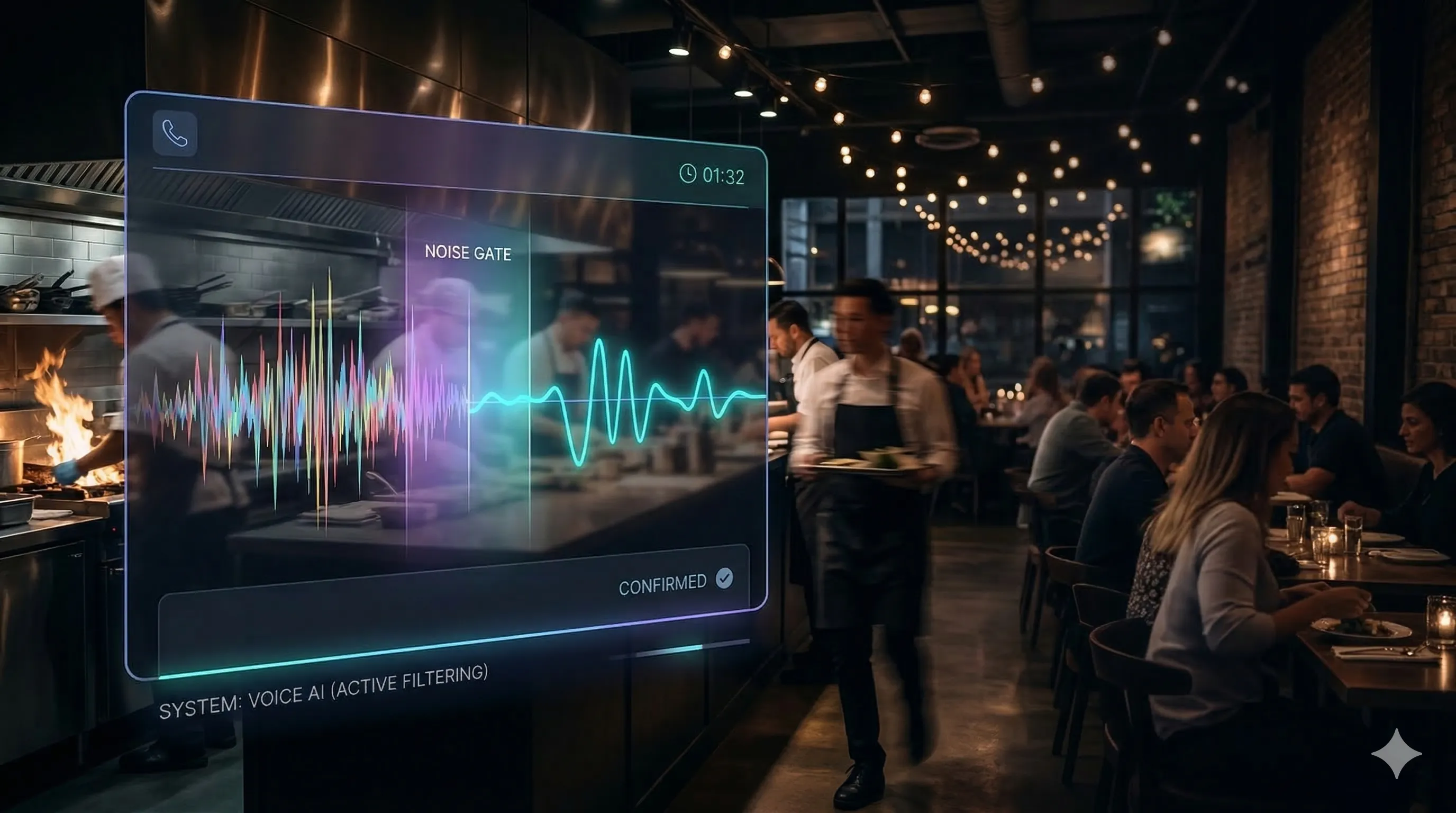
Baseline Calibration: Before deployment, we capture audio from your actual space across different service periods — quiet Monday lunch, busy Friday dinner, weekend brunch. The system learns your specific background noise, not a generic restaurant profile.
Dynamic Adjustment: Noise fluctuates constantly during service. The system adjusts its listening threshold in real-time, separating background noise from caller speech based on your venue's patterns.
Frequency Isolation: Human speech sits in predictable frequency ranges. Kitchen noise and extraction fans occupy different ones. The system focuses on where caller speech is most likely while filtering out the rest. This is venue-specific calibration — not generic noise cancellation.
Component 2: Understanding What Callers Actually Mean
Standard speech recognition writes down what it hears. This component focuses on understanding what callers actually mean.
Restaurant-Specific Vocabulary: The system is trained on your menu items — "paneer tikka", "rogan josh", "peshwari naan" — not generic food terms. It knows your location, your booking policies, your terminology. When audio is ambiguous, that context resolves it. "Balti" sounds like "party" in a noisy room, but in a restaurant call, context makes the right answer clear.
Phonetic Name Matching: "Patel" and "Pathan" sound similar. "Singh" has multiple pronunciations. The system finds the most likely match rather than requiring exact recognition — especially important for UK restaurants serving diverse communities.
Returning Caller Recognition: If your booking system identifies returning callers, the system accesses their history. "My usual table" becomes meaningful because there's context to reference.
Component 3: Faster Booking Conversations
This is how we cut booking conversations from 8–12 exchanges down to 4–6.
Extract First, Ask Second: When a caller says "I'd like to book for four next Saturday at 7:30 for my wife's birthday," that's five pieces of information in one sentence. The system pulls out everything already given, then asks only for what's missing — rather than working through a script question by question.
Logical Question Order: Questions follow a sensible sequence. No point asking about high chairs before confirming children are coming. Questions are ordered based on what's already known.
Single Confirmation: Instead of "Four people? Yes. Saturday? Yes. 7:30? Yes." — the system confirms everything at once:
"That's a table for 4 at 7:30pm this Saturday for a birthday, under the name Williams. You'll receive a confirmation text shortly. Anything else?"
Caller hears everything back. Errors get caught. Call ends faster.
Component 4: Knowing When To Hand Off
This is where most restaurant phone systems fail — not on simple calls, but by mishandling calls they should never have touched.
Two Strikes, Then Escalate: Two failed attempts trigger an immediate escalation offer. After two failures, patience is gone. A third attempt damages your reputation — even if the booking eventually succeeds.
Frustration Signals: The system watches for speech rate increasing, callers interrupting, repetition ("I SAID four people"), or explicit requests to speak to someone. Any of these triggers an immediate offer to transfer — not after the current flow finishes.
Warm Handover: The system briefs the staff member before transferring:
"Transferring now. Caller is booking for Saturday evening, party of four, birthday. Uncertain about dietary options."
The human picks up informed. The caller doesn't repeat themselves.
Calls That Should Always Go To A Human:
- Complaints about previous visits
- Large party negotiations (12+ guests)
- Private event enquiries
- Anything with emotional undertones
The system routes these to a human before attempting to handle them.
Voice AI Vs. Human Receptionist: The Honest Comparison
| Human Receptionist | AI Phone System (Noise-Gate) | |
|---|---|---|
| Availability | Shift hours only | 24/7 including after hours |
| Simultaneous calls | One at a time | Unlimited |
| Cost (monthly) | £1,800–£2,400 incl. on-costs | Significantly less |
| Background noise | Unaffected | Requires proper calibration |
| Complex or emotional calls | Yes | No — escalates to staff |
| Consistency | Variable | High, once configured |
| After-hours bookings | Missed | Captured |
The practical answer for most UK restaurants: use both. The AI handles routine calls and restaurant phone orders. Staff handle anything requiring genuine judgement or empathy.
A human receptionist is still the right choice for high-touch venues where nearly every call is complex. For busy independents losing calls during service, a restaurant phone system with voice AI makes the stronger case.
How Missed Calls Affect Your Revenue
Every unanswered call is a booking that doesn't happen.
The caller doesn't leave a voicemail. They don't try again. They find the next restaurant and book there.
This hits hardest when phones are busiest — Friday and Saturday evenings, Sunday lunch, the Christmas run-up. The same times your team can least afford to step away. A table for four at £40 a head, missed three times a week, is over £450 in lost revenue — before you count repeat visits or referrals.
The cost isn't just the missed booking. It's the guest who never becomes a regular.
Implementation: What The Process Actually Looks Like
The Noise-Gate Protocol isn't a quick install. It's a structured four-week process.
Week 1 — Environment Mapping: Audio samples captured across service periods. Call recordings reviewed (with consent). Common questions, booking workflows, and menu details documented.
Week 2 — System Configuration: Audio processing calibrated. Speech recognition trained on your vocabulary. Conversation flows and escalation rules built around your operation.
Week 3 — Controlled Testing: The system runs alongside existing phone handling. Staff hear responses before callers do. Problems are caught and fixed in real-time.
Week 4 — Monitored Deployment: Every call reviewed for the first week. Failures addressed. Staff feedback incorporated.
Ongoing: Menus change. Seasonal hours change. The system needs regular updates — typically 2–4 hours monthly for a single-location restaurant.
"Set and forget" does not exist in restaurant voice AI. Any vendor telling you otherwise is not being straight with you.
What This Framework Solves
| Failure Mode | Generic AI | Noise-Gate |
|---|---|---|
| Background noise | Keeps asking to repeat | Adapts to your venue's noise profile |
| Unfamiliar accent | Fails or guesses | Phonetic matching + domain context |
| Ambiguous request | Over-clarifies or guesses | Specific, contextual follow-up |
| Caller frustration | Continues script regardless | Detects frustration, escalates immediately |
| Complex request | Attempts and fails | Routes to human before attempting |
| Long conversation | 8–12 turns, caller drops | 4–6 turns through smarter data collection |
Is This Right For Your Restaurant?
Good fit:
- Multi-location restaurant groups
- Busy independents (100+ covers)
- Hotels with significant phone booking volume
- Any UK hospitality business missing calls during service
Not designed for:
- Quiet, low-volume establishments
- Venues where every call needs a personal touch
- Operations without capacity for ongoing maintenance
This solves specific problems. If you don't have those problems, you don't need this solution.
Frequently Asked Questions
Can the Noise-Gate Protocol work with any voice AI vendor?
The principles are transferable, but implementation requires vendor cooperation. Most off-the-shelf products don't offer the environment calibration or domain-specific training that makes this work. You'd need a vendor willing to customise significantly, or a purpose-built solution. Generic plug-and-play platforms rarely perform reliably in high-noise hospitality environments.
How long before the system handles calls reliably?
Expect 4–6 weeks before it's genuinely production-ready. Week one handles most routine calls adequately. The following weeks catch edge cases and environment-specific issues that only appear over time. Any vendor promising reliable performance from day one is describing a demo, not a real deployment.
What ongoing maintenance does a restaurant AI phone system need?
Plan for 2–4 hours monthly for a single-location restaurant. This covers menu updates, seasonal hour changes, booking policy adjustments, and reviewing escalated calls. Multi-location groups will need more. Ongoing maintenance is what keeps the system accurate — it's not optional.
How does voice AI compare in cost to hiring a receptionist?
A dedicated receptionist in the UK typically costs £1,800–£2,400 per month including salary, National Insurance, and holiday cover — and still can't handle simultaneous calls or after-hours enquiries. A voice AI platform costs significantly less and scales without shift constraints. The trade-off is that skilled staff handle complex or emotional calls better, which is why escalation matters.
What calls should never go to an AI phone system?
Complaints, large party negotiations, private event enquiries, and anything emotionally sensitive should always go to a human. A well-configured system recognises these and routes them before attempting to handle them — not midway through a failed attempt.
Is voice AI worth it for smaller independent restaurants?
Often more so than for larger groups. Smaller teams have less capacity to answer phones during service, so missed calls hit harder. The Noise-Gate Protocol is used in both single-site independents and multi-location groups — the setup differs, but the core problems are the same.
Further Reading
- How a 4-Location UK Restaurant Chain Cut Booking Time in Half
- AI Phone Answering for Restaurants & Hospitality
- Stop Missing Restaurant Calls During Busy Hours
This document reflects our methodology as of March 2026. We update it after each deployment.