Missed calls in restaurants occur when staff are unable to answer phones during peak hours, leading to lost bookings and revenue. Unlike manual handling, AI-powered voice systems can answer every call instantly and capture customer intent without delay.
The short version: Restaurants miss 30-40% of calls during peak hours because staff are busy serving tables. Voicemail doesn't work (UK diners don't leave messages). The cost isn't just one lost booking—it's ~£2,700/night in lost revenue and lifetime value.
The 7 PM Friday Paradox: Why Success Creates Silence
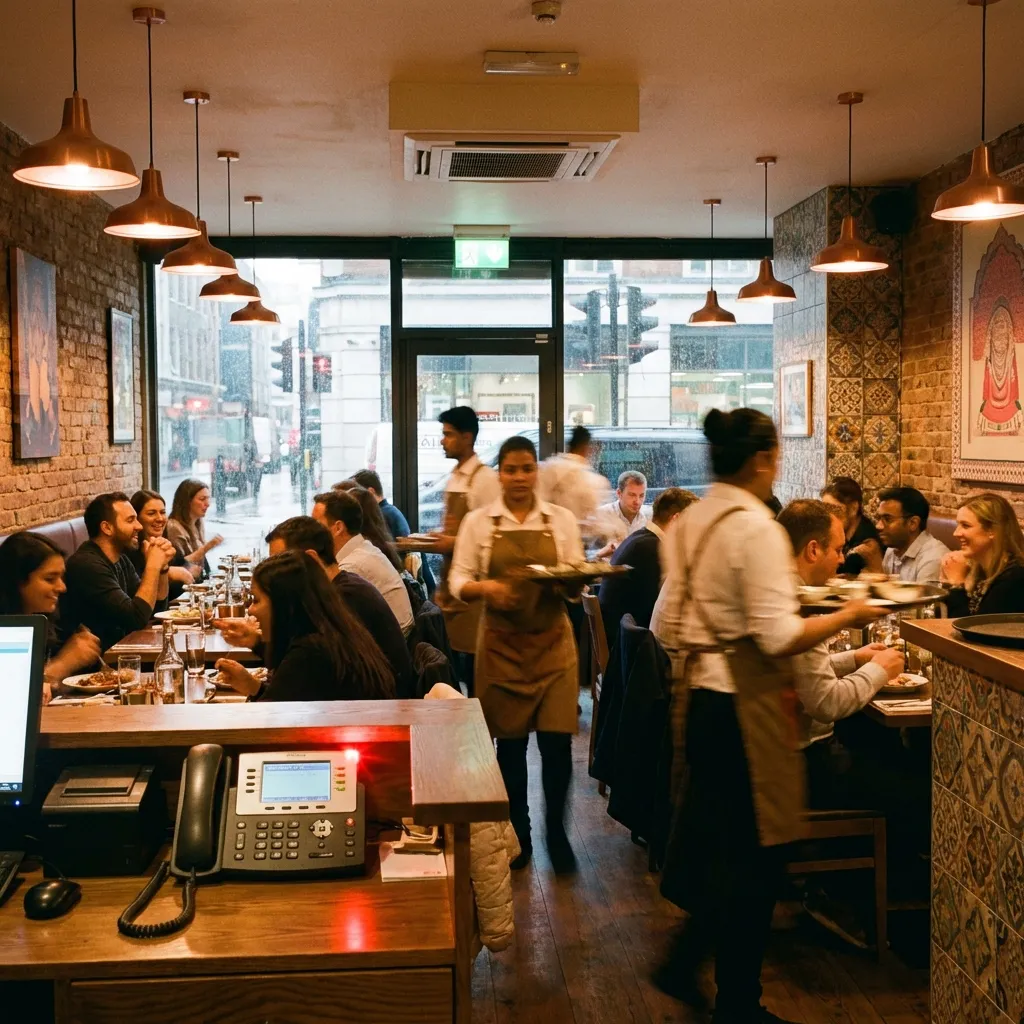
Your restaurant is packed. Tables are turning. The kitchen is firing on all cylinders. And somewhere, a phone is ringing into the void.
This is the paradox nobody talks about: your busiest moments—the proof your restaurant works—are exactly when you're bleeding potential customers. The couple trying to book for their anniversary. The office manager arranging a team dinner for twelve. The regular who always orders the lamb rogan josh on Fridays.
Gone.
Not because you're failing. Because you're succeeding.
The standard advice is maddening. "Just answer the phone." Right. While your host is seating a party of eight, your server is dealing with a dietary emergency, and your manager is smoothing over a complaint at table four. The phone becomes background noise—a problem for Later, which never comes.
Quantifying the Invisible Loss: Covers, Not Just Calls
Here's where restaurants get the maths wrong. They think about missed calls. They should think about missed covers.
One missed call isn't one lost booking. It's potentially four covers for tonight, plus the birthday party they would have booked next month, plus the three friends they would have recommended you to. The ripple effect is brutal.
Working with a four-location Indian restaurant chain in the UK, we tracked this properly. Not just calls answered versus calls missed, but actual revenue attribution. The numbers were uncomfortable. A single busy Friday evening could see fifteen to twenty calls go to voicemail. At an average party size of three, with an average spend of £45 per head, that's potentially £2,700 walking to competitors. In one evening.
Multiply that across a year. Now you understand why "we're too busy to answer phones" is actually "we're too busy to grow."
We also break down why booking errors happen →
Why 'Just Hire More Staff' Is a Broken Strategy
The obvious solution: hire a dedicated phone person. But anyone running a UK restaurant right now just laughed.
Hospitality staffing is a nightmare. Retention is worse. Training someone to handle reservations properly—understanding your table configurations, your dietary protocols, your VIP guests, your waitlist logic—takes weeks. Then they leave for a better offer, and you start again.
And even if you find this magical phone person, what do they do at 3 PM on a Tuesday? You're paying someone to sit idle for hours, then scramble desperately during the ninety-minute Friday rush. The economics simply don't work.
One restaurant owner put it bluntly after their third phone-person quit in six months: "I've spent more on recruitment fees than I would have on refurbishing the bar."
The Voicemail Graveyard: Why UK Diners Don't Leave Messages
American restaurants have a slight advantage here. Their customers will leave voicemails.
British diners won't.
This isn't a stereotype—it's observable behaviour. The call goes to voicemail, there's a brief pause, and then... click. No message. No callback request. Just silence, followed by a booking at the competitor down the road who did answer.
Why? Cultural awkwardness about talking to machines. Uncertainty about whether anyone checks messages. The assumption that voicemail means "this restaurant doesn't care enough to answer." None of these assumptions are fair, but fairness doesn't fill tables.
The voicemail graveyard isn't a backup system. It's where bookings go to die.
What's Actually Working for UK Restaurants
Some restaurants are finding ways around this. Not by hiring more staff—the economics don't work. Not by accepting voicemail as a backup—British diners don't leave messages.
The ones succeeding are using automated systems to handle the routine calls—the "are you open Sunday?" and "table for two at 7pm" queries—while routing anything complicated to humans immediately.
It's not perfect. Nothing is. But it's the difference between missing 40% of Friday calls and missing 5%.
The UK Context: How British Hospitality is Adapting
Something is shifting in British hospitality. The stubborn resistance to automation is cracking—not because owners suddenly love technology, but because they've run out of alternatives.
The restaurants adapting fastest share a common trait: they're not replacing humans with machines. They're using machines to protect human interactions. Let automation handle the tenth call about opening hours. Let automation manage the straightforward two-top booking on a quiet Wednesday. Free your actual humans for the moments that need human judgement—the complicated dietary requirement, the nervous proposal planner, the regular who deserves recognition.
This isn't about efficiency for efficiency's sake. It's about protecting the hospitality in hospitality.
Solving the Problem Without Losing Your Soul
Here's the uncomfortable truth about automation in restaurants: "Automation without escalation paths creates customer rage." We've seen it. Voice AI that can't hand off to a human when things get complicated doesn't just fail—it actively damages your reputation.
The restaurants getting this right build escape hatches into every automated system. The moment a caller says "this is a bit complicated" or "I need to speak to someone," the handoff happens instantly. No friction. No arguing with a robot.
They also accept that automation will never be 100% perfect. The goal isn't perfection—it's improvement. If you're currently missing 40% of Friday evening calls and automation drops that to 5%, you've transformed your business without promising the impossible.
The phone will still ring when you're slammed. The question is whether anyone—or anything—will answer.
FAQ
How many calls do restaurants actually miss during service?
Industry data suggests 30-40% of calls go unanswered during peak Friday/Saturday windows. The exact number depends on staffing levels and call volume.
Can't I just hire someone to answer phones?
The economics rarely work. A part-time phone person costs £600-800/month and still can't handle simultaneous calls during the 6-8pm spike.
Is voicemail a viable backup?
British diners don't leave voicemails. Callback rates are under 8%. By the time you return the call, they've booked elsewhere.
See how one restaurant chain solved their missed call problem →