Missed calls in restaurants occur when staff are unable to answer phones while managing in-person service during peak hours. Unlike staffing or training issues, this is a structural limitation where one person cannot handle both tasks simultaneously without impacting customer experience.
The short version: Restaurant phones ring hardest exactly when your team is busiest serving tables. This isn't a training problem—it's a physics problem. One person cannot be in two places at once, and no amount of hiring fixes the maths.
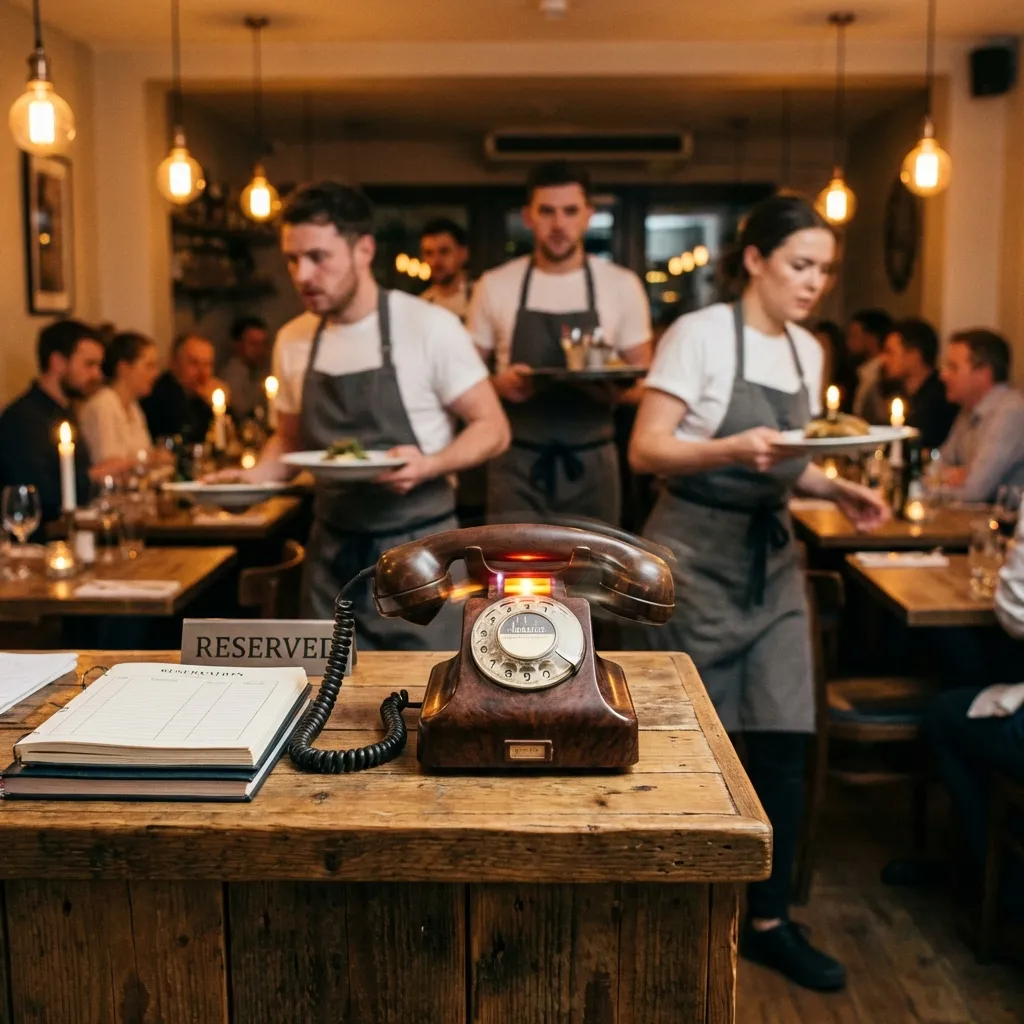
The phone rings at 6:47pm on a Friday. Your server is mid-pour on table 12's wine, explaining the specials to table 8, and mentally tracking that table 5's mains are running late. The phone keeps ringing.
This isn't a training problem. It's a physics problem.
The Impossible Choice: Guest in Front vs. Guest on the Phone
Every restaurant owner has watched it happen. A good server—properly trained, genuinely caring—glances at the ringing phone with something like guilt. They're torn between two paying customers, and someone's about to lose.
Pick up the phone? Table 12 gets interrupted mid-experience. The romance dims. The business meeting stalls. The birthday celebration loses momentum.
Ignore the phone? That's a booking walking out the door. Or worse, a complaint from a regular who just wanted to confirm their dietary requirements were noted.
Your staff aren't failing. They're being asked to be in two places at once.
One person. Two simultaneous demands. Zero good options.
And here's what makes it genuinely unfair: you're measuring them on both. Table satisfaction scores AND phone response rates. As if human attention were infinitely divisible.
The Maths That Kills "Just Hire a Phone Person"
The obvious solution sounds logical. Hire someone dedicated to phones.
Then you do the maths.
The 5pm-8pm window contains roughly 40% of your daily calls, compressed into 15% of your operating hours. A full-time phone handler sits idle most of the day, then drowns during the exact three-hour window when you need them most.
Part-time evening help? You're training someone for twelve hours a week. Turnover will be brutal. Consistency impossible. And they still can't handle the 6:45pm spike when eight calls come in simultaneously.
UK hospitality wages have climbed 12-15% since 2022. A dedicated phone person—even part-time—runs £600-800 monthly before you factor in recruitment costs, training time, and the inevitable replacement cycle.
For most independent restaurants and small chains, the economics simply don't close.
What's Actually on the Phone (And Why It's Maddening)
Here's what makes this problem sting.
Track your calls for a week. Actually log them. The pattern is frustrating:
- "What time do you close tonight?"
- "Do you take bookings or is it walk-in only?"
- "Is there parking nearby?"
- "Do you have gluten-free options?"
- "Can I see the menu somewhere?"
Information requests. The same questions, asked dozens of times weekly. Questions with fixed answers that haven't changed since you opened.
Your most skilled front-of-house staff—people trained to read body language, rescue difficult tables, make regulars feel recognised—pulled away to recite opening hours. Again.
Half your calls don't require human judgment. They require accurate information delivered clearly. The other half—the bookings you're actively losing during rush hour—do need attention. But your team can't give it while serving tables.
The Attention Tax: What Happens to Tables When Staff DO Answer
The phone gets answered. Problem solved?
Not quite.
Watch what happens to the dining room during a phone call. The server's attention fractures. They're physically present but mentally elsewhere. Table 14 tries to catch their eye for another bottle of wine. Table 9 has a question about the dessert menu. The kitchen window is filling up.
A three-minute phone call doesn't cost three minutes. It costs the recovery time afterwards—re-establishing presence, apologising for delays, rebuilding the rhythm of service.
One restaurant manager tracked it informally: each phone call during service created roughly seven minutes of disruption when you included the ripple effects. Multiply that by fifteen calls on a busy Friday. Nearly two hours of fragmented attention across your team.
The caller gets served. The diners get compromised service. And your staff absorb the stress of failing both while trying to serve both.
Why Training Cannot Fix Physics
The instinct is to train harder. Better phone scripts. Faster call handling. Prioritisation frameworks.
All of which assume the core problem is skill. It isn't.
You cannot train someone to give full attention to two conversations simultaneously. You cannot train someone to be physically present at a table while verbally present on a phone. You cannot train away the fundamental constraint: human attention is single-threaded.
Better training makes individual calls slightly more efficient. It does nothing for the underlying collision between phone demand and service demand happening at exactly the same hours.
The restaurants that "handle phones well" during service aren't better trained. They're better staffed—often to the point of economic inefficiency—or they've accepted a level of service compromise as normal.
The Shift Happening in UK Hospitality
Something is changing. Not universally, but noticeably.
Some UK restaurants have stopped pretending the problem is solvable through staffing alone. They're separating phone handling from floor service entirely—not by hiring dedicated phone staff (the maths still doesn't work), but by using systems that handle predictable queries automatically.
The logic: if half of calls are information requests with fixed answers, those calls don't need a human. Free your humans for the moments that actually require human judgment—the complex booking, the complaint, the regular who deserves recognition.
Not every restaurant is doing this. Not every restaurant should. High-touch fine dining may always want human voices on every call. Very small operations may not generate enough call volume to justify any system at all.
But for mid-market restaurants, casual dining, small chains running 2-5 locations? The calculation is shifting. The old model—staff answer phones when they can, callers wait or leave—is leaking too much revenue.
The Question Worth Asking
Your staff are doing their best with an impossible brief. The phone rings, the tables need attention, and someone loses every time.
The question isn't "how do we train them better?"
The question is "why are we asking humans to do something humans cannot physically do?"
Some restaurants are finding answers to that question. The approaches vary. The results vary. But the ones making progress share a common starting point: they stopped blaming staff for physics.
FAQ
How many calls do restaurants actually miss during service?
Industry data suggests 30-40% of calls go unanswered during peak Friday/Saturday windows. The exact number depends on staffing levels and call volume.
Can't I just hire someone to answer phones?
The economics rarely work. A part-time phone person costs £600-800/month and still can't handle simultaneous calls during the 6-8pm spike.
Is voicemail a viable backup?
British diners don't leave voicemails. Callback rates are under 8%. By the time you return the call, they've booked elsewhere.
See how one restaurant chain stopped asking their staff to be in two places at once →