Looking for implementation? See our voice AI development services for UK businesses.
Restaurants lose bookings on the phone when calls go unanswered or customer interactions are inefficient during busy periods. Unlike traditional phone handling, AI voice systems ensure every enquiry is captured and processed in real time.
The missed call problem gets all the attention. But there's a quieter killer: the bookings you do take that turn out wrong.
The short version: Industry estimates suggest that approximately 8–12% of manual restaurant bookings contain errors. In noisy environments (75+ dB), staff may mishear names, dates, and numbers. These "silent failures" often cost more than missed calls because they result in unhappy guests at the host stand. Wrong name. Wrong date. Wrong party size. Missing dietary requirement that surfaces when the guest is already seated.
These errors don't show up in any dashboard. They show up at the host stand, at 7pm on a Saturday, when someone insists they booked and you can't find them.
The Data Quality Crisis Nobody Tracks
Restaurants obsess over metrics. Food cost percentages. Covers per service. Average spend per head. RevPASH if they're sophisticated.
But booking accuracy? Almost nobody tracks it.
Here's a question most restaurant owners can't answer: what percentage of your phone bookings contain at least one error? Not catastrophic errors—just small ones. A misspelled name. A phone number missing a digit. "Allergic to nuts" that never made it into the notes.
Industry estimates suggest that approximately 8–12% of manually entered bookings contain some form of data quality issue. In high-volume restaurants during peak periods, that figure can increase further.
The maths is uncomfortable. A hundred bookings per week. Ten with errors. Four hundred potential service friction points per year. Some percentage of those become complaints. Some become bad reviews. Some become customers who simply never return.
When 80 Decibels Meets "Could You Spell That?"
Picture the environment where most phone bookings happen.
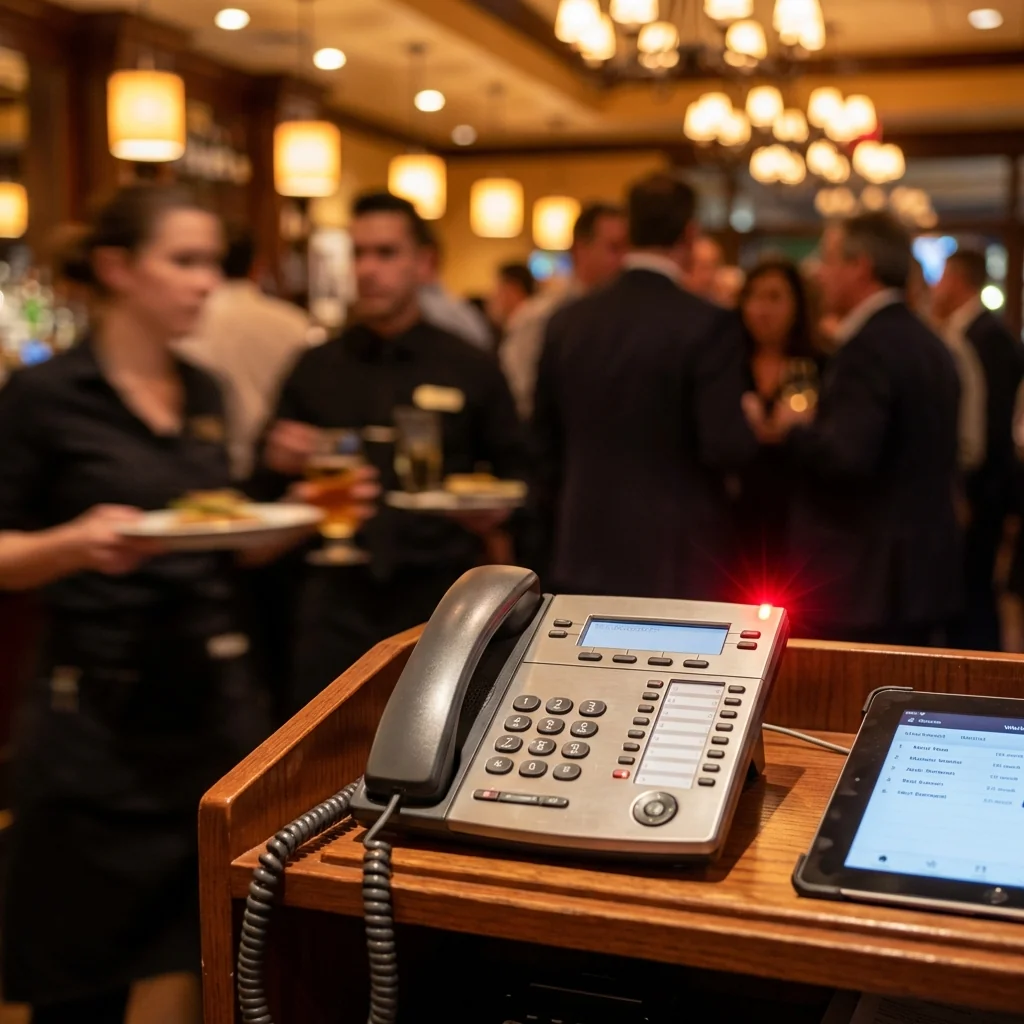
Hood fans running. Plates clattering. A server calling for a runner. The pass shouting orders. Background music. Customers chatting.
Noise levels during service regularly hit 75-85 decibels. That's equivalent to standing next to a busy road.
Into this chaos, your host answers the phone. The caller says their name. It's not Smith or Jones—it's something the host hasn't heard before. Maybe an accent. Maybe just unfamiliar.
What happens next determines everything.
The confident host asks for spelling. The busy host guesses. The embarrassed host writes down something close and hopes for the best.
One restaurant manager told us: "I've found bookings under 'Shawn', 'Sean', 'Shaun', and 'Shorn' in the same week. All the same regular."
That's not a training problem. That's an environment problem.
The "Next Saturday" Trap
Date confusion creates the bookings that vanish.
Customer calls on Thursday, asks for "Saturday." Which Saturday? This one in two days, or next week? Depends entirely on how both parties interpret the word "next."
Some people say "this Saturday" for imminent, "next Saturday" for following week. Others use "next Saturday" for the very next Saturday to occur. There's no universal standard.
Time compounds this. "Evening" means 6pm to some callers, 8:30pm to others. "Dinner" could be lunch if they're from certain parts of the North.
A staff member rushes, assumes, books the wrong date. The customer shows up seven days later. No table. No record. A confrontation at the host stand that poisons the entire evening—for the guest and for the staff member who now has to manage an angry stranger.
Phone Numbers: The +44 Problem
British phone numbers have a format problem that catches everyone.
Local callers give numbers starting with 0. International callers, expats, and business travelers often give +44 format. Some systems handle the conversion automatically. Many don't.
The failure mode is silent. Number looks complete. Gets entered. Nobody notices the missing digit until the confirmation call fails, the reminder text bounces, and the no-show gets marked down as another unreliable customer.
International guests—often your highest-spending segment—are disproportionately affected. They're also the least likely to call back when something goes wrong. They just don't return.
The Turnover Tax on Booking Quality
UK hospitality runs on turnover. Not the good kind—the staff kind.
Industry data suggests that 30–40% annual staff turnover is common in hospitality, with some segments experiencing even higher rates. This means a significant portion of your team may be in their first year—still learning your systems, your regulars, and the operational details that keep bookings running smoothly.
Every new host learns that Table 4 is actually two tables pushed together. That "the usual" for Mr. Patterson means the corner booth and a bottle of the Malbec ready. That large party bookings need a deposit mentioned upfront.
Then they leave. Someone new starts. The cycle repeats.
Consistency becomes genuinely impossible. Not difficult—impossible. The knowledge lives in people's heads, and those heads keep walking out the door.
The Handwriting Problem in the Digital Age
Some restaurants still use paper books. More than you'd think.
The failure mode is obvious: illegible handwriting, lost pages, no backup. But even digital systems suffer from the human input problem. Typing errors. Copy-paste mistakes. Autocorrect changing "Patel" to "Pastel."
The system is only as good as the data entered. And data gets entered by humans, under pressure, in noisy environments, often while doing three other things simultaneously.
One operations director put it bluntly: "Our booking system is state-of-the-art. Our data entry is Victorian."
What This Actually Costs
Booking errors create three types of cost:
Direct cost: The customer who shows up, finds no booking, and leaves. That's lost revenue tonight plus lost lifetime value.
Recovery cost: Staff time spent apologising, finding solutions, comping drinks or desserts. A manager's evening derailed by service recovery.
Reputation cost: The review that mentions "they lost our booking." The story told to friends. The social post. These compound in ways that don't appear on any P&L.
Most restaurants absorb these costs without quantifying them. They're written off as "just how it is." But aggregated across a year, across multiple locations, the number becomes substantial.
Why This Problem Is Getting Harder, Not Easier
Labour markets are tightening. Finding good hosts is harder than five years ago. Keeping them is harder still.
Customer expectations are rising. People accustomed to frictionless app-based experiences have less patience for "sorry, we can't find your booking."
And volume is returning. Post-pandemic dining is back, often exceeding previous levels. More covers, same staffing challenges, same fundamental booking infrastructure.
The pressure on accuracy is increasing from all directions. The tools available to most restaurants haven't changed.
Some operators are finding ways to address this—systems that remove the human error element from routine bookings while keeping staff focused on complex requests. Not a solution for everyone, but worth understanding if booking accuracy is costing you more than you've measured.
FAQ
How many calls do restaurants actually miss during service?
Industry data suggests 30-40% of calls go unanswered during peak Friday/Saturday windows. The exact number depends on staffing levels and call volume.
Can't I just hire someone to answer phones?
The economics rarely work. A part-time phone person costs £600–800/month and still can't handle simultaneous calls during the 6–8pm spike.
Is voicemail a viable backup?
In our UK restaurant deployments, we observed that British diners rarely leave voicemails, and callback rates are typically under 10%. By the time you return the call, many have already booked elsewhere.
See how one restaurant chain tackled their booking accuracy problem →